
 Sep 03, 2026
From smart factories to e-commerce warehouses, Automated Guided Vehicles (AGVs) have become indispensable intelligent robots for material handling and transportation. These driverless vehicles carry goods through busy production lines and logistics centres around the clock — and behind every smooth mission is a reliable power source. As a professional lithium battery manufacturer, UFOPOWER designs and builds custom AGV battery packs based on lithium iron phosphate (LiFePO4) technology, so fleet operators get long-lasting, stable energy with the level of safety that crowded work environments demand.
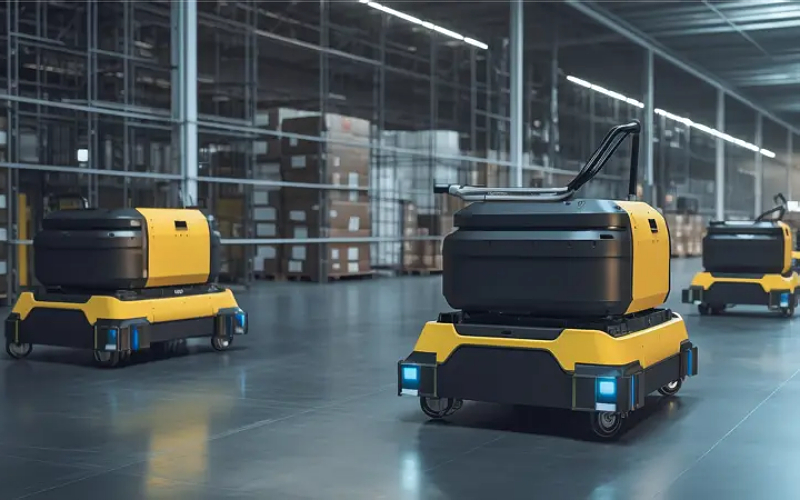
An AGV battery is the power source of an Automated Guided Vehicle — an automated, driverless electric vehicle used to move materials inside factories, warehouses and logistics centres. Because AGVs run long shifts and recharge frequently, their batteries must deliver three things at once: enough energy density to keep the vehicle working for extended periods, a high cycle life to survive constant charging and discharging, and a sealed, high-safety design that prevents leakage, overheating or other failures in the working environment.
Today, lithium iron phosphate (LiFePO4) is the mainstream chemistry for AGV batteries, because its combination of safety, longevity, low self-discharge rate and charging flexibility matches the demanding duty cycles of automated material handling.
AGV batteries powered by LiFePO4 chemistry offer a set of advantages that other lithium chemistries struggle to combine:
High safety. LiFePO4 cells are inherently stable and far less prone to overheating, explosion or fire than other lithium types — a critical factor when AGVs operate in crowded environments alongside people, racks and goods.
Long life. LiFePO4 batteries typically deliver a long cycle life and withstand frequent charge/discharge cycles, reducing replacement frequency and maintenance costs for fleets that run continuously.
Sufficient energy density. While its energy density is comparatively moderate, for most AGV scenarios it is more than enough — and in applications with strict safety requirements, the stability advantage matters far more.
Environmental friendliness. LiFePO4 batteries contain no heavy metals or toxic substances, supporting green factory and sustainability goals.
Fast charging. LiFePO4 supports around 1C charge and discharge, cutting downtime between shifts and improving the working efficiency and flexibility of the AGV.
To understand why AGV battery makers favour LiFePO4, it helps to compare it directly with other lithium chemistries such as NMC, lithium cobalt oxide or lithium polymer. LiFePO4 is inherently more stable: it is far less prone to overheating, explosion or fire — a decisive advantage when vehicles operate close to people. Its cycle life is longer, which means fewer pack replacements for fleets that charge several times a day. The trade-off is a somewhat lower energy density, but for most AGV duty cycles that is fully sufficient, especially when safety requirements come first.
| Feature | LiFePO4 (mainstream AGV choice) | Other lithium chemistries (NMC / LCO / LiPo) |
|---|---|---|
| Safety | High — stable, resistant to overheating, explosion and fire | Lower — higher thermal risk in dense work environments |
| Cycle life | Long — handles frequent charge/discharge | Shorter under the same duty cycle |
| Energy density | Moderate — sufficient for most AGV applications | Higher |
| Environmental impact | No heavy metals or toxic substances | May contain heavy metals / toxic materials |
| Fast charging | Supports around 1C charge/discharge | Varies by chemistry and cell design |
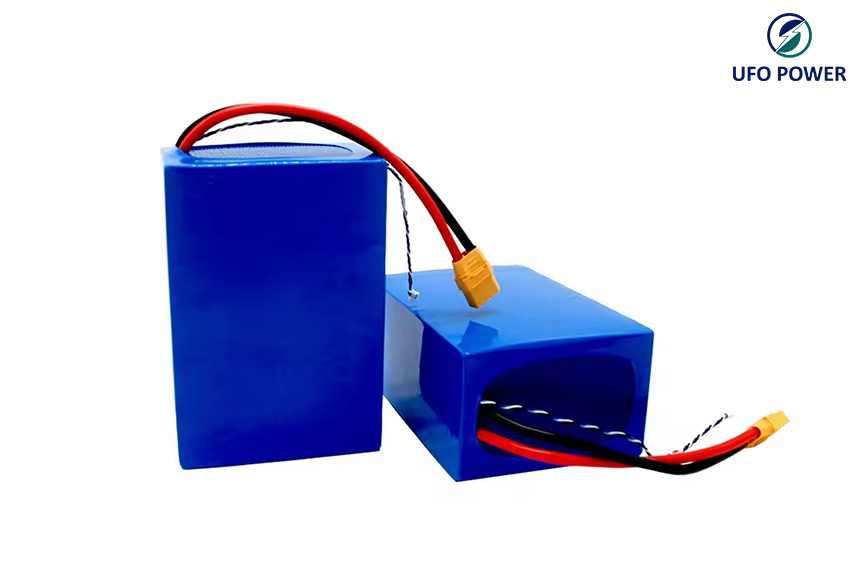
Choosing the right automated guided vehicle battery pack means matching the pack to your duty cycle, environment and budget. Working with a custom battery manufacturer makes this easier, because voltage, capacity and mechanical design can be tailored to your AGV instead of the other way around. The table below summarises the key parameters UFOPOWER helps customers evaluate when specifying a pack:
| Parameter | Why it matters | Typical guidance for AGV packs |
|---|---|---|
| Battery chemistry | Determines safety, cycle life and energy density | LiFePO4 recommended for AGV applications |
| Voltage | Must be compatible with the AGV motor and control system | Usually 12V–72V; can be customized for your vehicle |
| Capacity (Ah) | Determines how long the AGV runs before recharging | Sized to your shift and duty cycle |
| Cycle life | Number of charge/discharge cycles before degradation | Longer is better for frequently used AGVs |
| Operating temperature | Must suit the environment where the AGV works | Most AGV batteries: about -10°C to 60°C |
| Charging speed | Shorter charging time means less downtime | Fast charging (around 1C) boosts productivity |
| Weight and size | Affects AGV speed, agility and payload | Balance runtime needs against vehicle mobility |
| Safety and cost | Prevents overcharge, over-discharge and fire risk; cost varies by quality | Prioritize safety; evaluate lifetime value, not just price |
As a professional lithium battery manufacturer with in-house production lines, UFOPOWER offers factory-direct OEM/ODM custom battery solutions for AGV and AMR fleets. Our engineers start from your vehicle's specifications — motor voltage (typically 12V–72V), available compartment size, required capacity and charging schedule — and deliver a battery pack that fits without compromise. Lighter packs can increase AGV speed and agility, while larger packs extend runtime; a custom design lets you choose the right balance.
Each pack integrates a dedicated Battery Management System (BMS) that guards against overcharging, over-discharging and overheating, inside a robust sealed enclosure built for industrial environments. Every unit passes strict quality control with 100% factory testing before shipment and is manufactured to meet international safety standards for industrial lithium batteries. Whether you need a standard configuration or a fully customized design, UFOPOWER supports the complete process — from specification review and prototyping to production and after-sales service.
Why is LiFePO4 the preferred battery chemistry for AGV applications?
How should AGV batteries be maintained?
How safe are AGV batteries in the working environment?
Do you offer customized AGV battery solutions?
Can AGV batteries work in multiple environments?
Do AGV battery packs support fast charging?


 WhatsApp
 国家1
国家1 Home >